
March 11, 2026
CEO Frank Annicaro outlines service realignment, new mobility initiatives and a forward-looking vision for mobility in the Capital Region.
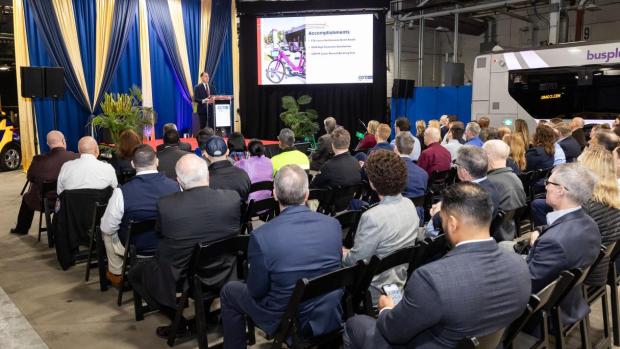
ALBANY, NY (March 11, 2026) The Capital District Transportation Authority (CDTA) outlined a year of major accomplishments, new initiatives, and a forward-looking vision for mobility in the Capital Region during its annual State of CDTA address on Wednesday, March 11, 2026.
In his first State of CDTA address as CEO, Frank Annicaro highlighted the organization’s continued focus on delivering reliable service, investing in innovation, and strengthening connections across the region.
“CDTA is strong and moving forward with purpose,” said CDTA CEO Frank Annicaro. “Our focus is simple: listen to our employees and customers, act, and deliver results that make a real difference in the communities we serve. Whether it’s improving service reliability, expanding mobility options like FLEX, or investing in cleaner technology, everything we do is about connecting people to opportunity and strengthening the Capital Region.”
Over the past year, CDTA introduced several initiatives designed to enhance customer experience. These efforts include the launch of a fare compliance campaign. Phase One was the “Respect the Ride. Pay Your Fare” campaign to promote fare compliance through education and awareness. Phase Two included the launch of the CDTA Ambassador Program, which places trained ambassadors from Tech Valley Security onboard buses to assist riders, answer questions, and help create a more welcoming environment.
The Authority has also taken steps to address customer and community concerns about bus shelter cleanliness by increasing the visibility of shelter crews and installing QR codes at shelters so riders can report issues directly to CDTA. The organization is also exploring new technology solutions, including AI-enabled tools to proactively identify shelter maintenance needs.
CDTA also celebrated several major accomplishments over the past year, including receiving a $32 million Low or No Emission Grant from the Federal Transit Administration to purchase hybrid-electric buses and invest in new asset management technology. The investment will help modernize the fleet while advancing the agency’s commitment to sustainability.
The organization’s services continue to see strong community support and growing demand. STAR paratransit service recorded one of its highest ridership months ever in October 2025 with more than 36,000 riders, while the region’s bike share program, CDPHP Cycle!, celebrated a record-breaking year with more than 100,000 rides in 2025.
CDTA is also working to align service with community needs through its Transit Development Plan, which outlines a five-year roadmap for the agency’s network. Early results from service adjustments show improved on-time performance and stronger reliability, while new connections, such as Route 713 linking Glens Falls and Saratoga Springs, are expanding regional mobility.
Looking ahead, CDTA is exploring opportunities to expand its FLEX On Demand microtransit service following strong success in Saratoga Springs, where riders wait an average of 20 minutes or less, as promised, and 98 percent of riders return to use the service again.
The Authority is also continuing to advance projects that support long-term regional growth, including transit-oriented development initiatives and plans to redevelop the former Daily Gazette building in Schenectady into a modern bus facility and training center. CDTA Board Chair Jayme Lahut said the organization’s progress reflects strong collaboration between employees, leadership, and the community.
“CDTA continues to demonstrate the vital role public transit plays in the success of our region,” said CDTA Board of Directors Chairman Jayme Lahut. “As a Board, we are committed to the role that CDTA plays in shaping the future of our region. Mobility is not just about moving people; we’re a driver of economic development and community growth. That’s why transit-oriented development remains a key priority for us.”
As part of its future planning, CDTA also unveiled a refreshed strategic framework, including updated core values and a new vision statement. CDTA’s vision is to “Unify the region through sustainable mobility – strengthening communities and positioning CDTA as a vital driver of growth by connecting people, places, and opportunity.”
CDTA has been working on defining success beyond ridership and has identified four key success outcomes that will guide its work: financial stability, customer engagement, community value, and employee engagement. These outcomes are measurable, and CDTA is committed to delivering results in each of these areas.
CDTA has grown into an organization with 775 employees and an annual budget of $135.7 million, serving approximately 18 million customers annually. It has also grown its fleet to 400 buses and vehicles, which travel 16 million miles annually on more than 74 different routes. It operates fixed route bus service, Bus Rapid Transit (BRT), and CDPHP Cycle! bikeshare, DRIVE carshare, STAR paratransit service, and FLEX On Demand.
###